
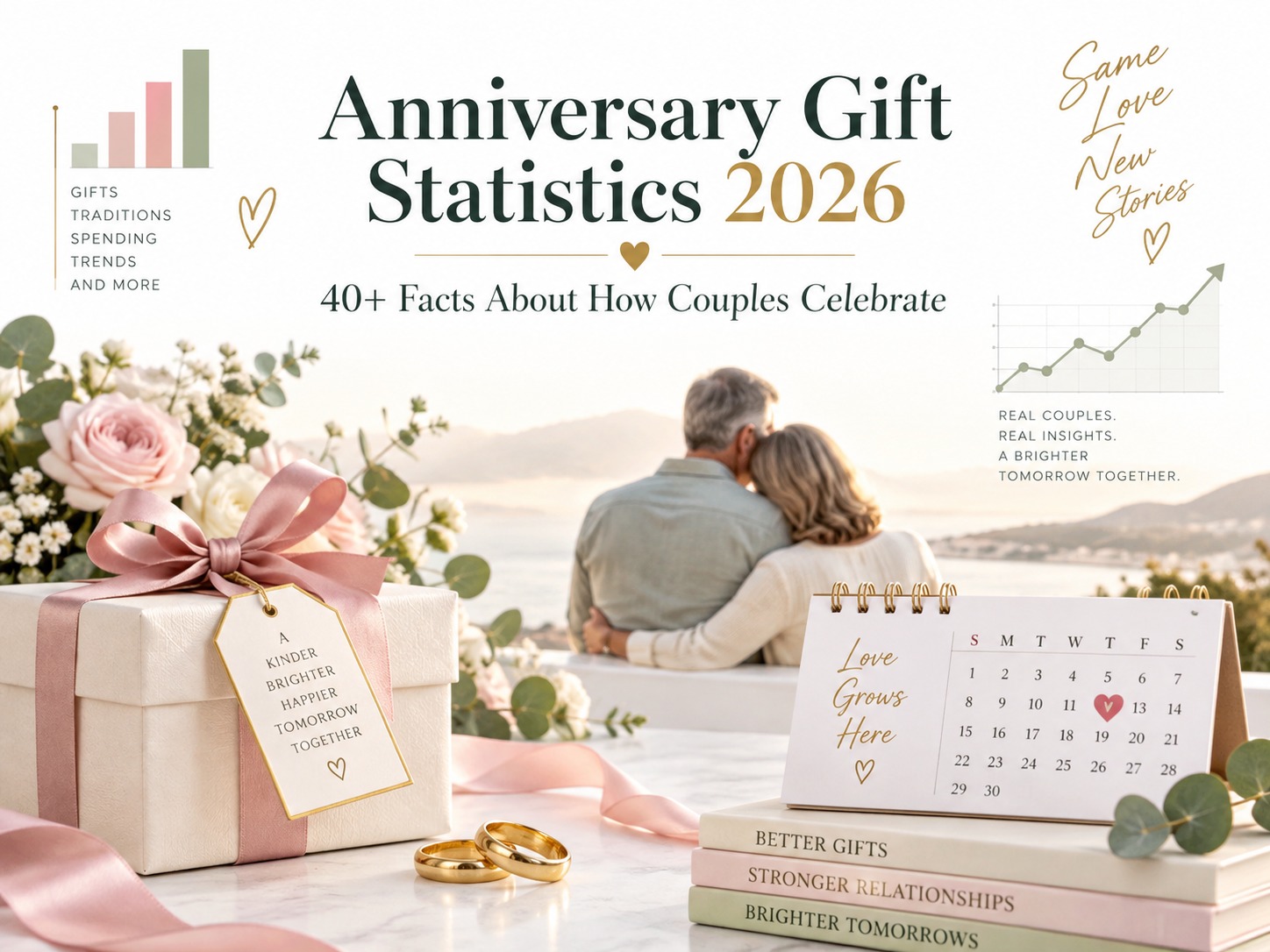
What Anniversary Gift Statistics Reveal About How Couples Celebrate in 2026
Anniversaries are personal, but the way couples choose gifts and celebrate important relationship milestones follows some surprisingly clear patterns.
To understand what matters when Americans celebrate their relationships, Anniversary Gifts By Year reviewed recent U.S. marriage data, nationally representative consumer research and academic studies into gift-giving, personalization and experiences.
Our analysis brings together findings from the U.S. Census Bureau, CDC, Pew Research Center, YouGov and peer-reviewed consumer research.
Because there is currently no large, nationally representative U.S. survey devoted exclusively to wedding-anniversary gift behavior, some sections use broader gift-giving research and romantic-occasion research as context. Where Valentine’s Day data is used, we identify it clearly as a proxy for how couples approach a dedicated romantic celebration—not as direct anniversary data.
Key Findings at a Glance
- 50% of both U.S. men and women say they buy gifts for a spouse or significant other.
- 34% of partnered Americans planned to exchange a Valentine’s gift in 2026, compared with 32% who planned to dine out.
- 45% of people in relationships say Valentine’s planning is shared equally between partners.
- 26% of Americans have been disappointed because a partner did not do enough to celebrate Valentine’s Day.
- Quality time is more than five times as likely as receiving gifts to be named Americans’ preferred “love language”: 38% versus 7%. This is an Anniversary Gifts By Year calculation from YouGov data.
- 19% of married Americans say they rarely or never go on dates with their spouse.
- Research published in the Journal of Consumer Research found that experiential gifts strengthen relationships more than material gifts in the experiments studied.
- Experimental research involving customized gifts found that personalization increased gift appreciation and recipients’ self-esteem.
- Historical Census research found that 35% of currently married couples had reached their 25th anniversary and 6% had passed their 50th anniversary in the underlying 2009 data.
- By 2014, more than half of men and women whose first marriages began between 1970 and 1984 had reached at least their 25th wedding anniversary.
Anniversary and Marriage Statistics
Before looking at gifts, it helps to understand the population actually celebrating wedding anniversaries.
| # | Finding |
|---|---|
| 1 | 47% of U.S. households were married-couple households in 2025. |
| 2 | Fifty years earlier, married couples accounted for 66% of U.S. households. |
| 3 | That represents a 19-percentage-point decline, or about a 29% relative decrease, according to our calculation using Census figures. |
| 4 | In 2023, 51% of U.S. adults were married, according to Pew’s analysis. |
| 5 | Another 7% of adults were living with an unmarried partner in 2023. |
| 6 | The United States recorded 2,041,926 marriages in 2023. |
| 7 | The 2023 U.S. marriage rate was 6.1 marriages per 1,000 people. |
| 8 | The median age at first marriage in 2025 was 30.8 for men and 28.4 for women. |
| 9 | The resulting median first-marriage age gap was 2.4 years, based on our calculation of Census figures. |
| 10 | In 1996, the corresponding median ages were 27.1 for men and 24.8 for women. |
| 11 | Compared with 1996, the median age at first marriage has therefore risen by approximately 3.7 years for men and 3.6 years for women. This is our calculation from Census figures. |
| 12 | Among currently married adults in 2016, 76% of men and 77% of women were in their first marriage. |
What this means for anniversary gifting
Marriage is happening later than it did several decades ago, while married-couple households make up a smaller share of American households. At the same time, millions of marriages still take place annually, creating a large continuing population of couples marking yearly anniversaries.
How Common Are Major Wedding Anniversaries?
Long-lasting marriages turn milestones such as the 25th and 50th anniversaries into relatively distinctive occasions.
| # | Finding |
|---|---|
| 13 | Historical Census data found that 55% of currently married couples had been married at least 15 years. The underlying data are from 2009 and should be read as historical rather than current estimates. |
| 14 | In the same Census analysis, 35% had reached their 25th wedding anniversary. |
| 15 | Only 6% had passed their 50th wedding anniversary, illustrating how uncommon a golden anniversary is. |
| 16 | By 2014, more than half of both men and women in first marriages that began between 1970 and 1984 had reached at least their 25th anniversary. |
| 17 | Among divorces occurring in 2023, 16% involved marriages of less than five years. |
| 18 | Another 24% of 2023 divorces occurred after five to nine years of marriage. |
| 19 | Together, 40% of divorces occurred within the first decade of marriage. |
| 20 | At the other end of the spectrum, 22% of 2023 divorces involved marriages that had lasted at least 25 years. |
| 21 | The median duration of marriages ending in divorce increased from 10 years in 2008 to 12 years in 2023. |
These statistics help explain why landmark anniversaries carry particular significance. A 25th or 50th anniversary is not simply another date on the calendar—it represents decades of shared history.
How Do Couples Celebrate Romantic Occasions?
There is no recent national survey asking Americans exactly how they celebrate wedding anniversaries. The best current comparison is YouGov’s February 2026 study of 1,114 U.S. adults examining how couples planned to mark Valentine’s Day. We use these findings as indicators of romantic-celebration behavior, not as direct wedding-anniversary statistics.
| # | Finding |
|---|---|
| 22 | 52% of Americans currently in a romantic or sexual relationship planned to celebrate Valentine’s Day in 2026. |
| 23 | 34% of partnered Americans planned to give or receive a gift. |
| 24 | 32% planned to dine out at a restaurant. |
| 25 | Gift exchange therefore edged dining out by 2 percentage points among partnered Americans in this romantic-occasion survey. |
| 26 | 30% of people in relationships said sex would be part of their Valentine’s celebration. |
| 27 | Across all Americans, 17% planned to celebrate by sharing a meal at home. |
| 28 | Another 17% planned to give or receive a card. |
| 29 | 45% of partnered Americans said responsibility for planning Valentine’s activities was shared equally. |
| 30 | 20% said they were personally primarily responsible for planning the occasion. |
| 31 | 13% said their partner was primarily responsible. |
| 32 | Men were more likely than women to say they were the main planner: 23% versus 16%. |
| 33 | 26% of Americans said they had been disappointed because a partner did not do enough to celebrate Valentine’s Day. |
| 34 | Among women, 39% reported having experienced that disappointment, compared with 13% of men—a three-to-one difference. |
| 35 | Among people in relationships, 77% described themselves as very or somewhat romantic. |
| 36 | 72% rated their current relationship as excellent or very good—39% excellent and 33% very good. |
The lesson for anniversaries
These data suggest that a meaningful romantic celebration does not necessarily revolve around one expensive object. Gifts, meals, shared planning and time together all play a role.
Expectations matter too. The large gender difference in reported disappointment over insufficient Valentine’s celebrations suggests that acknowledging the occasion itself can be important, even when the celebration is simple.
Do Married Couples Still Go on Dates?
Anniversary gifts compete with another powerful way of celebrating a relationship: spending time together.
A 2025 YouGov study found a gap between how frequently Americans date and how often they would like to. The survey explicitly told partnered respondents to include dates with their current spouse or partner.
| # | Finding |
|---|---|
| 37 | 39% of U.S. adults say they rarely or never go on dates. |
| 38 | Among married Americans, that figure drops to 19%. |
| 39 | Among people in unmarried relationships, 20% say they rarely or never go on dates. |
| 40 | Only 16% of Americans say they would prefer to rarely or never go on dates, compared with the 39% who actually do so rarely or never—a 23-percentage-point gap. |
| 41 | Restaurant lunches and dinners were the most commonly reported types of date experiences. |
| 42 | Among date experiences people had not tried, some of the activities generating the most interest included watching a sunrise or sunset, going to the beach and stargazing. |
For anniversary gift buyers, this supports a useful idea: an anniversary present can combine an object with an experience—for example, jewelry plus dinner, a personalized keepsake plus a weekend trip, or a photo book followed by a visit to a meaningful location.
Who Buys Gifts for Romantic Partners?
YouGov’s April 2026 analysis of U.S. gift-giving behavior provides one particularly relevant finding for anniversary shoppers:
Men and women are equally likely to report buying gifts for their spouse or significant other: 50% of each group.
Other relationships show much larger gender differences.
| # | Finding |
|---|---|
| 43 | 50% of women say they buy gifts for a spouse/significant other. |
| 44 | 50% of men say the same, making romantic partners one relationship where the gender difference disappears. |
| 45 | Women are more likely to buy gifts for friends: 52% versus 38% of men. |
| 46 | Women are also more likely to buy for parents: 43% versus 35%. |
| 47 | For adult children, the figures are 34% of women versus 24% of men. |
| 48 | 21% of men say they do not buy gifts at all, compared with 13% of women. |
The romantic-partner result stands out: despite differences elsewhere in the gifting landscape, gift-buying for spouses and partners is equally common among men and women in this dataset.
What Matters Most When Choosing a Gift?
The occasion itself is the strongest reported influence on gift selection among both genders, making anniversary-specific symbolism particularly relevant.
| Gift-selection factor | Women | Men |
|---|---|---|
| Occasion | 69% | 62% |
| Closeness to recipient | 59% | 49% |
| Budget | 59% | 45% |
| Recipient’s preferences | 51% | 37% |
| Usefulness | 45% | 35% |
Source: YouGov Profiles, April 2026.
Several insights follow from these figures.
The occasion ranks first, reinforcing the usefulness of choosing gifts connected to an anniversary’s traditional or modern theme.
But personalization matters in another sense: 51% of women and 37% of men say recipient preference influences their gift choice. A theoretically “correct” anniversary gift is therefore unlikely to beat something genuinely suited to the recipient simply because tradition says paper, cotton, silver or gold.
Budget also matters, particularly among women, which supports providing anniversary ideas across inexpensive, mid-range and luxury price levels.
What Types of Gifts Do Americans Buy?
The most commonly reported categories in YouGov’s 2026 gifting research were practical, broadly appealing products rather than extremely niche items.
| Gift category | Women | Men |
|---|---|---|
| Food and drink | 45% | 36% |
| Clothing and accessories | 43% | 30% |
| Vouchers/gift cards | 42% | 34% |
| Toys and games | 36% | 28% |
| Electronics | 11% | 16% |
| Sports equipment | 6% | 8% |
YouGov also reports that books and personalized gifts rank relatively highly for both groups.
For anniversaries, the takeaway is not that one category is universally “best.” Rather, successful anniversary gifts can combine the familiar with the personal: a favorite food paired with a handwritten note, jewelry carrying an anniversary stone, or an ordinary household item engraved with a meaningful date.
Are Gifts Really the Best Way to Show Love?
Interestingly, Americans don’t necessarily rank receiving gifts as their favorite way of experiencing affection.
In a nationally representative YouGov survey of 1,000 U.S. adults, participants were shown descriptions of the five commonly discussed “love languages” and asked which they preferred.
| Preferred way to receive love | Share ranking it first |
|---|---|
| Quality time | 38% |
| Physical touch | 24% |
| Words of affirmation | 19% |
| Acts of service | 13% |
| Receiving gifts | 7% |
That produces one of the most useful findings in this study:
Quality time was about 5.4 times as likely as receiving gifts to be selected as Americans’ top preference for receiving love.
This is our calculation based on YouGov’s 38% and 7% figures.
That does not mean anniversary gifts are unimportant. It suggests that the best anniversary gift may work better when it creates or supports another form of connection.
A weekend away combines gifting with quality time. A handwritten anniversary letter combines a gift with words of affirmation. Preparing a special meal combines acts of service with shared time.
Do Couples Understand How Their Partners Want to Be Loved?
YouGov found some evidence of mismatched preferences between partners.
Among people whose preferred mode of affection was quality time, 43% said their partner also preferred quality time. Alignment was lower for several of the other categories.
Meanwhile, 73% of men in relationships said their partner did an excellent or good job expressing love in the way they preferred, compared with 64% of women.
This is another argument against selecting an anniversary gift solely because a list says it is appropriate for a particular year. The anniversary tradition can provide the theme; knowledge of the partner should determine the actual present.
Personalized Anniversary Gifts: What Does the Research Say?
Personalization is one of the strongest recurring themes in anniversary gifting, and academic research provides evidence for why customized presents can feel more meaningful.
Researchers from the University of Bath, emlyon business school, SKEMA Business School and Università della Svizzera italiana conducted four experimental studies examining customized gifts.
In one study, 74 participants gave clothing to a friend. Recipients of personalized gifts changed fewer items in the outfit than recipients of non-personalized gifts, which researchers interpreted as greater appreciation.
A second experiment showed 134 participants gift-selection videos involving either customization of a T-shirt or conventional online gift selection. Customized gifts generated greater appreciation even when researchers accounted for time and effort spent choosing the gift.
Further experiments involving a mug and wristwatch found that customization increased gift appreciation and enhanced recipients’ self-esteem.
For anniversary shoppers, that supports gifts incorporating details such as:
names, wedding dates, coordinates, photographs, meaningful locations, song lyrics or titles, handwritten messages, shared memories and significant milestones.
The important factor is not simply putting a name on an object. Personalization works best when it communicates that the gift was deliberately created for that particular recipient.
Experiences vs. Physical Anniversary Gifts
Another important finding comes from research published in the Journal of Consumer Research.
Researchers Cindy Chan and Cassie Mogilner examined real-life gift exchanges and found that experiential gifts produced greater improvements in relationship strength than material gifts.
Crucially, this effect did not depend on the giver and recipient actually experiencing the gift together. Researchers linked the stronger relationship effect to the emotions generated while the recipient consumed the experience.
This makes experiential anniversary gifts particularly compelling:
a concert, cooking class, weekend trip, spa treatment, tasting experience, photo session, theater performance or return visit to somewhere meaningful to the relationship can potentially create both a celebration and a new shared memory.
A particularly strong approach may be to pair the experience with a smaller physical keepsake.
Sentimental Gifts May Be Undervalued by Givers
Research into sentimental gifts has identified another mismatch between gift givers and recipients.
A series of studies published in the Journal of Consumer Psychology found that gift givers tend to choose sentimentally valuable gifts less frequently than recipients would prefer.
Givers can worry about choosing the wrong sentimental present and instead select something that obviously matches the recipient’s known preferences. Recipients, however, may place greater value on gifts connected to meaningful relationships and memories.
Anniversaries are unusually well suited to sentimental gifting because couples have a built-in history to draw from: wedding photographs, first trips, favorite songs, places they have lived, children and family milestones, handwritten notes and moments that became part of their story.
Anniversary Gift and Relationship Statistics: What We Learned
Taken together, the evidence suggests several broader patterns.
First, anniversary gifting remains relevant. Half of both men and women in YouGov’s latest general gifting analysis report buying gifts for spouses or significant others.
Second, a gift is only one part of a romantic celebration. In current romantic-occasion data, partnered Americans combine gift exchanges with restaurant meals, home meals and shared activities.
Third, time may matter more than things. Quality time substantially outranks gift receiving as Americans’ preferred way of experiencing affection, while experimental research finds that experiential gifts can strengthen relationships more than material gifts.
Fourth, personalization has evidence behind it. Experimental research suggests customized gifts increase appreciation and can enhance the recipient’s self-esteem.
Finally, milestone anniversaries are genuinely significant. Historical Census data show that reaching a 50th anniversary is much less common than reaching a 15th or 25th, giving major wedding milestones meaning beyond their traditional gold, silver or diamond themes.
What Is the Best Anniversary Gift According to the Research?
There is no single gift that the data says every spouse should receive.
Instead, the research points toward a formula:
Personal relevance + recognition of the occasion + emotional meaning + shared experience.
That could be an engraved piece of jewelry followed by dinner, a personalized photo album alongside a weekend away, a handwritten letter accompanying a traditional anniversary material, or an experience connected to an important memory.
The price of the gift alone is unlikely to provide the meaning. What matters is whether the gift shows that the giver knows the recipient and recognizes the relationship being celebrated.
Methodology
This report was prepared by Anniversary Gifts By Year in September 2026.
It is a secondary-research analysis, not an original consumer survey.
We reviewed data from U.S. government agencies, nationally representative polling organizations and peer-reviewed academic research relating to marriage, romantic celebrations, gift-giving and gift preferences.
U.S. marriage data
Marriage totals and rates were sourced from the U.S. Centers for Disease Control and Prevention’s National Center for Health Statistics. The most recent national figures displayed by the CDC at the time of research are provisional 2023 data.
Marriage and household characteristics were sourced from the U.S. Census Bureau’s Current Population Survey and published Census analyses.
Historical anniversary-duration figures are identified as historical and are not represented as 2026 estimates.
Gift-giving research
General U.S. gift-giving figures were sourced from YouGov Profiles research published April 14, 2026. That research examines differences in gifting behavior between U.S. men and women.
Romantic-celebration research
The 2026 romantic-celebration statistics come from a YouGov survey conducted January 29–February 1, 2026 among 1,114 U.S. adult citizens, weighted to be representative of U.S. adults. The reported overall margin of error was approximately four percentage points.
Because the survey concerns Valentine’s Day rather than wedding anniversaries, this report uses those results only as a proxy for romantic-occasion behavior.
Dating and shared-experience research
Dating-behavior figures come from YouGov research published February 4, 2025.
Love-preference data comes from a nationally representative YouGov survey of 1,000 U.S. adult citizens conducted January 27–31, 2022, with an approximate margin of error of three percentage points.
Academic gift research
Findings about experiential gifts are based on research by Cindy Chan and Cassie Mogilner published in the Journal of Consumer Research.
Findings about customized gifts are based on four experimental studies reported by researchers associated with the University of Bath, emlyon, SKEMA Business School and Università della Svizzera italiana and published in Psychology & Marketing.
Findings concerning sentimental gifts draw on published consumer-psychology research examining the differences between what givers choose and what recipients prefer.
Anniversary Gifts By Year calculations
Where this report calculates differences, ratios or percentage changes using published figures—for example, the 5.4-to-1 comparison between quality time and gift receiving—we identify these as our calculations based on the cited underlying data.
Percentages have been rounded where appropriate.
Sources
Primary and major research sources used in this report include:
U.S. Census Bureau — Families and Living Arrangements; Number, Timing and Duration of Marriages and Divorces; historical marital-status data.
Centers for Disease Control and Prevention / National Center for Health Statistics — Marriage and Divorce national statistics.
Pew Research Center — U.S. marriage, divorce and relationship-duration analysis.
YouGov — 2026 U.S. gift-giving research; 2026 Valentine’s Day and relationship survey; 2025 dating research; U.S. love-language research.
Journal of Consumer Research — Chan & Mogilner, Experiential Gifts Foster Stronger Social Relationships Than Material Gifts.
Psychology & Marketing — research on recipient responses to customized gifts.
Journal of Consumer Psychology — research concerning sentimental value and gift choice.
Citation and Media Use
Journalists, researchers and publishers are welcome to reference findings and calculations from this report.
When citing original calculations or analysis from this page, please credit:
AnniversaryGiftsByYear.co — “Anniversary Gift Statistics 2026”
and link to this study as the source.
Last researched: September 2026
Next scheduled review: 2027